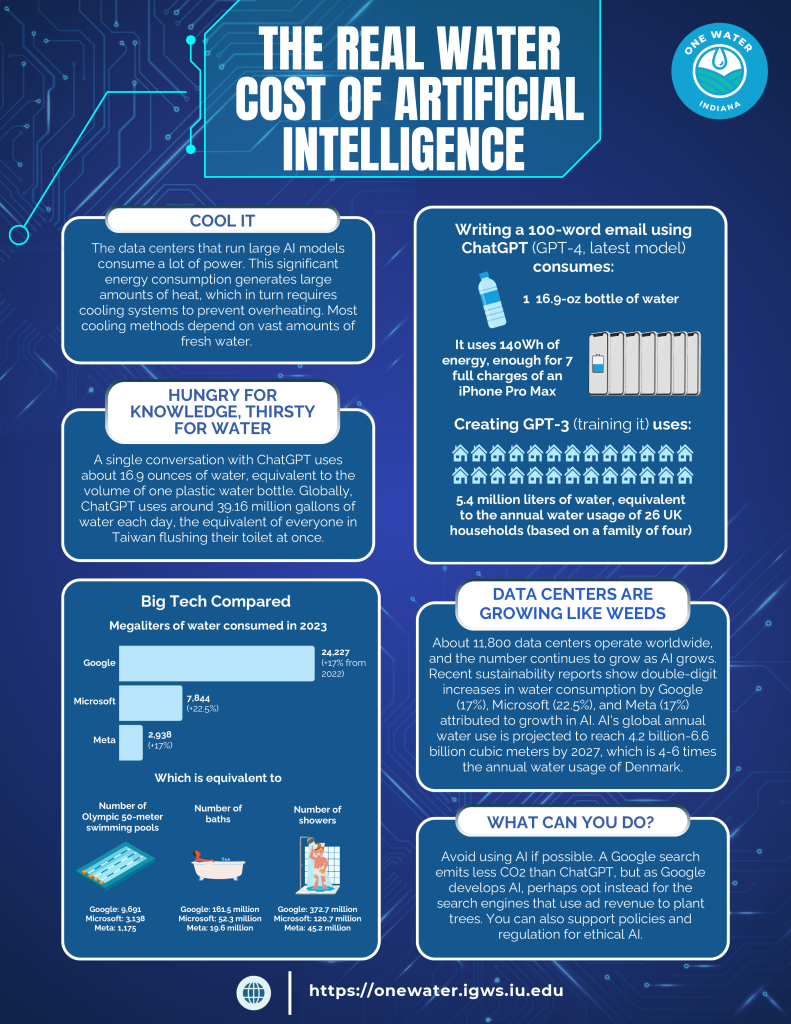
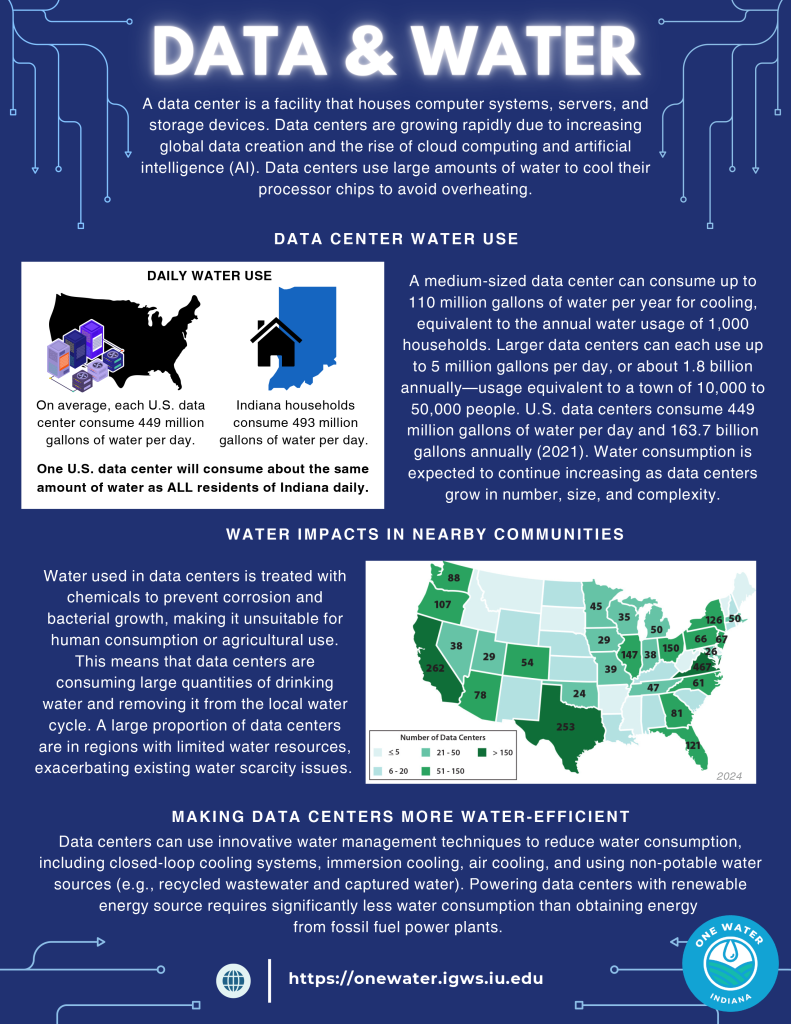
It may seem impossible to avoid artificial intelligence chat bots and search results these days, but there are hidden costs to our water supply as data centers that house computing resources continue to expand.
Artificial intelligence, often referred to as AI or machine learning, is a high demand computing process. Large models process large amounts of data…. which require large amounts of energy and generate large amounts of heat. What is often used to prevent overheating of these systems? You guessed it – large amounts of water.
According to One Water Indiana, recent sustainability reports show heavy increases in water consumption with the rise of AI – Google and Meta increased water use in recent years by 17% and Microsoft by 22.5%. Additionally, one U.S. data center consumes about the same amount of water used by ALL residents of Indiana each day.
On a personal or business level, you might think about your use of AI and water in terms of daily activities and their impact:
- A single ChatGPT conversation uses the amount of water 1 plastic water bottle
- Using ChatGPT to write a 100-word email uses the amount of water 1 plastic water bottle
- Training a GPT-3 model uses 5.4 million liters of water (about the annual water usage of 26 UK households of a family of 4)
But don’t we have plenty of water in Indiana?
While most regions of Indiana currently do not have water scarcity issues, that does not let us off the hook in terms of planning for the future or allowing any and all water use cases. As water quantities decrease, the concentration of particles such as sediment, chemicals, and other pollutants increases. Water utilities would need to spend more citizen dollars to improve the water collection and treatment systems to get enough clean drinking water.
What can you do?
Whether you are a business or individual, everyone can take action to protect our drinking water. In terms of AI, be mindful of your use. Use search engines such as Ecosia that plant trees. Be an informed consumer and keep track of water legislation and advocate in your community. Share infographics with friends and family such as these two from One Water Indiana, a partnership of multiple Indiana organizations spearheaded by the Indiana Geological and Water Survey. Remember – every drop counts!